What Anthropic's 466,000-Square-Foot Manhattan Lease Tells Us About the Office Market
The dominant office narrative of the last few years has been simple: remote work hollowed out demand, vacancy climbed, values fell. That story isn't wrong for a lot of the market — but it's incomplete, and Anthropic's latest move in Manhattan is a useful data point for why.
The Deal
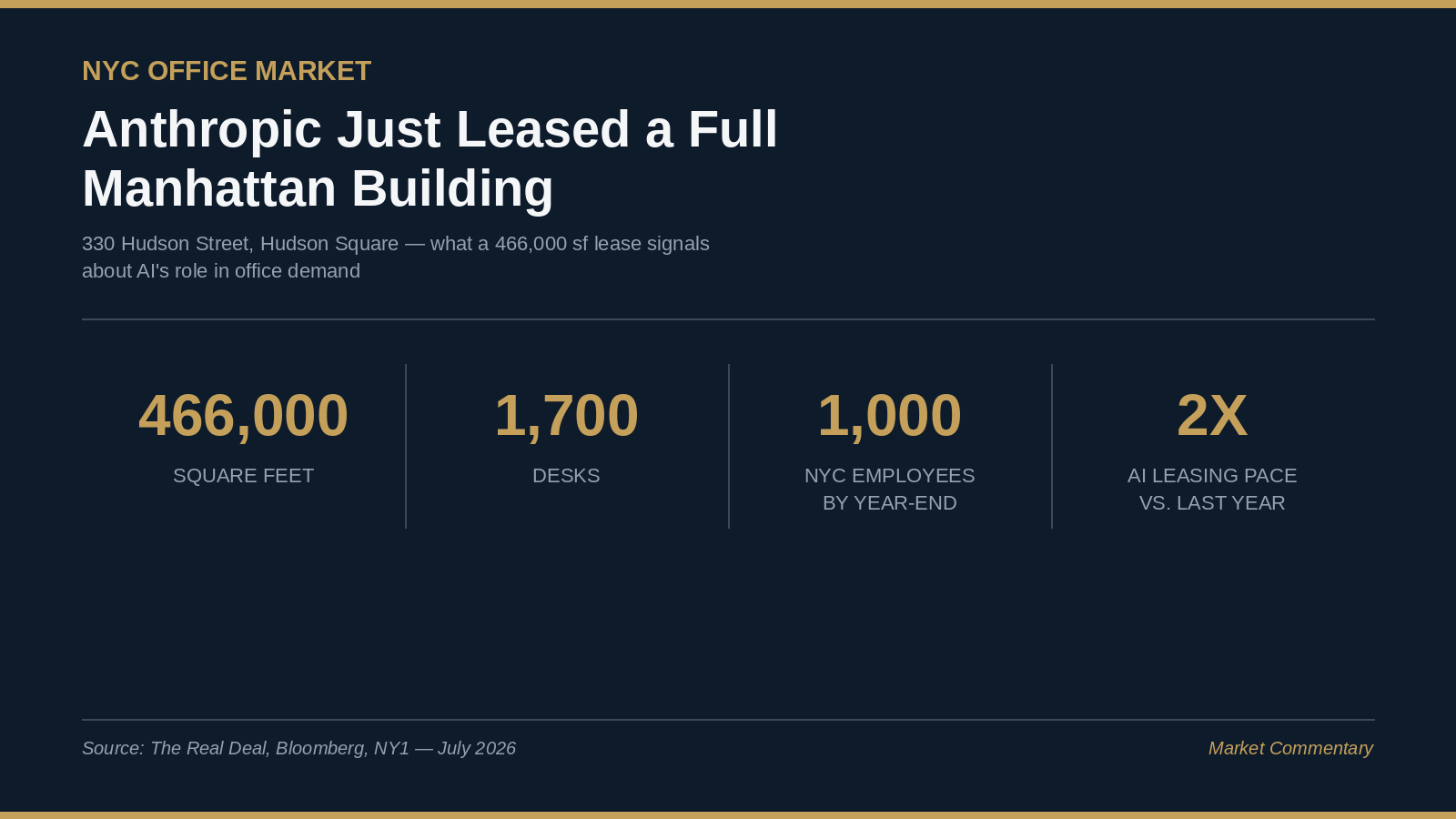
Anthropic has finalized a lease for the entire 16-story building at 330 Hudson Street in Manhattan's Hudson Square neighborhood, taking the building from landlord AEW Capital Management. The space totals roughly 466,000 square feet — big enough for about 1,700 desks. The company is moving from a 15,000-square-foot footprint at 155 Sixth Avenue (a lease signed two years ago, expiring this year) into a space more than thirty times that size. Existing tenants in the Hudson Street building, including Deloitte, the Financial Times, and marketing agency Anomaly, will need to vacate before Anthropic's planned move-in this summer. The company has said it intends to double its New York headcount to roughly 1,000 employees by the end of 2026, up from under 500 at the start of the year.
Why One Lease Matters Beyond the Headline
A single tenant taking a full building is notable on its own, but the context is what makes it a market signal rather than a one-off. AI companies leased office space at roughly twice last year's pace through early 2026, and AI tenants accounted for more than a third of all tech-sector office demand in Manhattan in the first quarter alone — about 670,000 square feet. Anthropic's building isn't an outlier; it's the largest visible example of a trend that's already showing up across the leasing data.
What This Changes for Owners, Brokers, and Appraisers
Absorption Assumptions
For years, tech-sector office demand modeling leaned on a fairly narrow set of tenant profiles — media, ad tech, traditional SaaS, financial services. AI labs are a new category, and they don't behave like the tenants underwriting models were built around: headcount growth curves are steep, funding is venture-scale rather than revenue-scale, and space needs can shift faster than a typical five- or ten-year lease cycle would suggest. Anyone underwriting lease-up risk or absorption timelines in CBD office product needs to treat this as a distinct demand driver, not a subset of "tech."
Submarket Concentration
Hudson Square and Midtown South have been the early beneficiaries of this demand. Whether that concentration holds or spreads to other submarkets — and other cities — is the open question. If it spreads, it's a genuine tailwind for a broader set of office owners. If it stays concentrated, it risks creating a two-tier market: a small number of buildings that can credibly market to AI tenants, commanding a premium, and everything else competing on price.
Rent and Pricing Signals
Full-building leases from a single, well-capitalized tenant give landlords and brokers a cleaner comp than the fragmented multi-tenant leasing that's dominated the last few years. Expect asking rents in buildings positioned to compete for this tenant profile — large contiguous blocks, strong infrastructure, walkable to talent pools — to firm up faster than the broader office average.
The Caveat
It's one lease, one tenant, and one submarket. AI labs are also unproven as long-term office tenants — none of them have been through a full real estate cycle, a downturn, or a scaled-back hiring plan yet. A demand driver built on venture funding and hiring projections carries different risk than one built on established, diversified revenue. Landlords and lenders underwriting to this tenant class should treat the growth curve as a forecast, not a fact, and stress-test accordingly.
Bottom Line
Office isn't dead, and it isn't uniformly recovering either — it's bifurcating, and AI tenants are now a real part of that story in gateway markets. The buildings that can accommodate this tenant profile are seeing real, immediate demand. The rest of the market is still working through the older story of remote work and downsizing. Both are true at the same time, and the spread between them is where the next few years of office value will be decided.
Market commentary based on public reporting. This is not investment advice and not an opinion of value.